
Running a small business in 2026 means competing for customers, managing daily operations, creating content, answering questions, and keeping costs under control—all at the same time. The good news is that artificial intelligence can now handle many repetitive tasks that once required hours of manual work.The Best AI Tools for Small Businesses in 2026 can help entrepreneurs write marketing content, create designs, analyze information, automate workflows, communicate with customers, manage projects, and improve productivity. However, choosing the right tool can be difficult because there are hundreds of AI platforms available.
This guide compares some of the most useful AI tools for small businesses based on their features, use cases, pricing considerations, advantages, and limitations. Whether you run an online store, agency, local business, startup, or personal brand, there is likely an AI solution that can save you time and help your business grow
.[IMAGE PLACEMENT: Add a featured image showing a small-business owner working with AI tools on a laptop.]Suggested ALT text: Best AI Tools for Small Businesses in 2026.

AI is no longer limited to large technology companies. Small businesses can use AI without hiring a large technical team or building complicated software.
For example, a business owner can use AI to draft an email campaign in minutes, generate social media ideas, summarize a meeting, create a presentation, or automate a repetitive administrative task.
The biggest benefits include:
- Saving time: AI can automate repetitive work.
- Reducing costs: Businesses can accomplish more without adding employees for every task.
- Improving productivity: Employees can focus on higher-value responsibilities.
- Better marketing: AI can help create and organize content faster.Faster customer service:
- AI assistants can answer common questions.Better decision-making: AI can help analyze large amounts of information.Scalability:
- Small teams can handle workloads that previously required larger teams. The key is not to use AI simply because it is popular. Businesses should choose tools that solve specific problems and provide measurable value.
15 Best AI Tools for Small Businesses in 20261.
1: ChatGPT Best Overall AI Assistanthttps://www.chatgpt.com
ChatGPT is one of the most versatile AI tools available to small businesses. It can assist with writing, brainstorming, research, customer communication, business planning, coding, data analysis, and many other tasks.
A small business owner can use it to create blog outlines, write product descriptions, develop marketing ideas, prepare customer-service responses, analyze documents, or brainstorm new business strategies.
Key Features
- AI writing and brainstorming
- Content creation
- Data analysis
- Document assistance
- Business planning
- Research support
- Coding assistance
- Custom workflows and assistants, depending on the plan
Best For
Entrepreneurs, marketers, freelancers, agencies, creators, and small teams that need a general purpose AI assistant.
Pros
- Extremely versatile
- Easy to use
- Useful for many business departments
- Can save significant time
Cons
- Output should be reviewed for accuracy
- Advanced capabilities may require a paid plan
- It should not replace human judgment for important business decisions
Pricing
ChatGPT offers free and paid plans, with pricing and included features varying by plan and changing over time.
Why it stands out: If a business wants one AI tool that can assist with many different tasks, ChatGPT is one of the strongest choices

2. Canva Best for AI Design and Marketing
Canva is particularly useful for businesses that need professional-looking graphics without employing a full time designer.
Its AI-powered features can help users generate designs, create presentations, edit images, write copy, and produce marketing materials.
Key Features
- AI-assisted design
- Social media graphics
- PresentationsImage editing
- Marketing templates
- Brand management
- Video creation
Best For
Small businesses, social media managers, marketers, creators, and entrepreneurs.
Pros
- Beginner friendly
- Huge template library
- Excellent for social media
- Useful for branding
Cons
- Some advanced features require paid plans
- AI- generated designs may still need manual editing
Pricing
Canva has a free option and paid plans. Exact pricing depends on the plan and region.
Why it stands out: Businesses can produce professional marketing materials without advanced graphic design skills.
3 Grammarly Best for Business Writing
Professional communication matters. Emails, proposals, website copy, reports, and social media posts can all affect how customers perceive a company.
Grammarly uses AI to help users improve grammar, clarity, tone, and overall writing quality.
Key Features
- Grammar checking
- Spelling correctionTone suggestions
- Rewriting assistance
- AI writing support
- Business communication assistance
Best For
Businesses that frequently communicate with customers, clients, employees, and partners.
Pros
- Easy to useImproves communication
- Helpful for non native English writers
- Works across many writing environments
Cons
- Some advanced features require payment
- AI suggestions should still be reviewed
Pricing
Grammarly provides free and paid options, with premium business capabilities available depending on the subscription.-
4. HubSpot Best for AI Powered Marketing and CRM
Small businesses often struggle to organize customer relationships. HubSpot combines CRM, marketing, sales, customer service, and other business functions in one ecosystem.
Its AI capabilities can assist with content creation, customer management, sales activities, and marketing workflows.
Key Features
- CRMAI assisted content
- Marketing automation
- Sales tools
- Customer service
- Reporting and analytics
BEST For
Growing businesses that want to organize sales and customer relationships.
Pros
- Strong CRM capabilities
- Multiple business functions in one platform
- Useful automation
- Scalable
Cons
Some advanced features can become expensiveThe platform can take time to learnPricingHubSpot provides free and paid products.
Pricing
varies significantly depending on the tools, seats, and features selected
5. Zapier Best for AI Automation
Zapier is designed to connect different applications and automate repetitive workflows.
For example, a business could create a workflow where a new form submission automatically enters a spreadsheet, creates a task, sends a notification, and triggers another action.
Key Features
- Workflow automation
- App integrations
- AI assisted automation
- Multi step workflows
- Business process automation
Best ForSmall businesses that spend too much time moving information between different applications.
Pros
- Saves timeConnects many popular applications
- Powerful automationReduces repetitive administrative work
Cons
- Complex workflows can take time to configure
- Higher usage can require a paid plan
Why it stands out: Automation can turn repetitive business processes into systems that operate with minimal manual intervention.
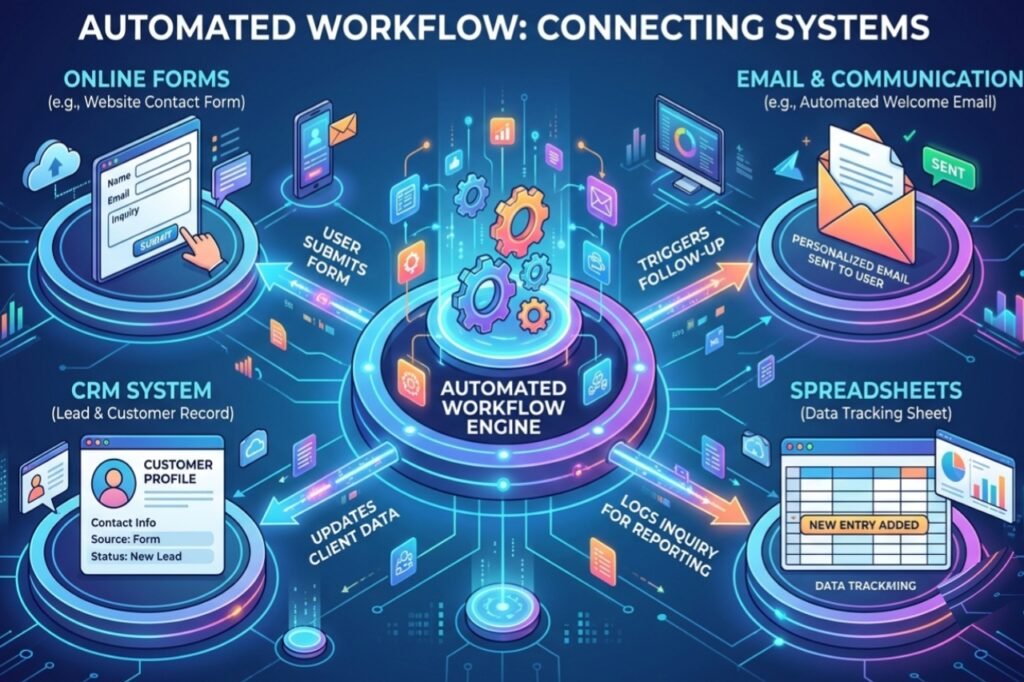
[IMAGE PLACEMENT: Add an infographic showing how an automated workflow connects forms, email, CRM, and spreadsheets.]
6. Notion AI Best for Business Organization
Notion combines documents, notes, databases, project management, and collaboration. Its AI capabilities can help teams summarize information, generate content, organize ideas, and search business knowledge.
Key Features
- AI writingSummaries
- Knowledge management
- Project management
- Team documentation
- Database organization
Best For
Small teams that need one central place for business information.
Pros
- Flexible
- Excellent for organizing information
- Useful collaboration features
- Combines multiple functions
Cons
- Flexibility can make it overwhelming for beginners
- Advanced AI features may require payment
7. Microsoft Copilot Best for Microsoft Users
Businesses already using Microsoft products can benefit from AI capabilities integrated into Microsoft’s ecosystem.Copilot can assist with tasks involving documents, spreadsheets, email, meetings, presentations, and other productivity workflows, depending on the product and subscription.
Key Features
- AI assistance
- Document support
- Email assistance
- Presentation help
- Spreadsheet assistance
- Productivity workflows
Best For
Businesses already using Microsoft 365.
Pros
- Fits into an existing productivity ecosystem
- Useful for office work
- Reduces repetitive tasks
Cons
- Availability varies by Microsoft product and subscription
- Some advanced features require additional licensing
8. Google Gemini Best for Google Workspace Users
Google Gemini can be particularly useful for businesses already using Google Workspace and other Google services.It can assist with writing, brainstorming, research, summarization, and productivity tasks
.Best For
Businesses using Gmail, Google Docs, Google Drive, and other Google services.
Pros
- Strong integration with Google’s ecosystem
- Useful for writing and research
- Familiar environment for Google Workspace users
Cons
- Features depend on the plan and product
- AI generated information should be reviewed-
9. Grammarly Business Best for Team Communication
For businesses with several employees communicating with customers, consistent writing quality can be valuable.AI writing assistance can help teams maintain clearer and more professional communication.
Useful For
- Customer emails
- Sales messagesInternal communication
- Website copy
- Marketing materials
Pros
- Consistent communication
- Easy to implement
- Helps improve clarity
Cons
- Subscription costs increase with team size.
- Human review remains important.
10. Descript Best for AI Video Editing
Video marketing is increasingly important for small businesses. Descript makes video editing easier by allowing users to work with video through a transcript-based editing approach.It can be particularly useful for podcasts, interviews, tutorials, marketing videos, and social content.
Key Features
- Transcript based editing
- AI assisted editing
- CaptionsAudio improvement
- Video production tools
- Best ForCreators, agencies, educators, podcasters, and businesses producing video content.
Pros
- Simplifies editingUseful for spoken contentGood for repurposing videos
Cons
- Some advanced capabilities require paid plans
- Professional editors may prefer specialized software for complex projects
11. Jasper Best for Marketing Content
Jasper focuses heavily on business and marketing content. It can help teams generate marketing copy, campaign ideas, and brand focused content.
Best For
Marketing teams and businesses producing large amounts of promotional content.
Pros
- Marketing focusedUseful for campaigns
- Helps speed up content production
Cons
- Paid focused platform
- Content still requires editing and fact checking
Frequently Asked Questions
What are the Best AI Tools for Small Businesses in 2026?
There is no single tool that is best for every company. ChatGPT is a strong general-purpose option, while Canva is excellent for design, Zapier for automation, HubSpot for CRM and marketing, and tools such as Intercom can help with customer support.
Can a Small Business Use AI for Free?
Yes. Many AI platforms offer free plans or limited free features. However, paid plans often provide higher usage limits, advanced capabilities, additional integrations, or business features.
How Much Do AI Tools Cost?
Pricing varies considerably. Some tools are free, while others charge monthly or annual subscription fees. Businesses should compare the cost against the amount of time or money the tool can save.
Can AI Replace Small Business Employees?
AI can automate certain tasks, but it does not eliminate the need for human judgment, creativity, relationships, leadership, and accountability. Most small businesses should view AI as a productivity tool rather than a complete replacement for employees.
What Is the Best AI Tool for Marketing?
The answer depends on the marketing task. Canva is strong for visual content, Jasper can assist with marketing copy, HubSpot provides marketing and CRM capabilities, while general purpose AI assistants can support campaign planning and content development.
Is AI Safe for Business Data?
Businesses should carefully review the privacy, security, and data handling policies of every AI service before entering confidential information. Sensitive business information should only be used in tools and workflows that provide appropriate protections.
Should a Small Business Use Multiple AI Tools?
Yes, when each tool serves a different purpose. However, businesses should avoid subscribing to too many overlapping services. A small, well-integrated AI toolkit is often better than a large collection of unused subscriptions.
Final Verdict: The Best AI Tools for Small Businesses in 2026
The Best AI Tools for Small Businesses in 2026 are not necessarily the tools with the most impressive features. The best tools are the ones that solve real business problems, save valuable time, improve productivity, and provide a reasonable return on investment.
For an all purpose AI assistant, ChatGPT is a strong starting point. Canva is excellent for businesses that need visual content, while Zapier is valuable for automation. Businesses focused on customer relationships may benefit from HubSpot, while Notion AI can help teams organize knowledge and projects.
The most important thing is to start with your business needs rather than the technology itself. Identify repetitive tasks, choose an appropriate tool, test it, measure the results, and keep human oversight where accuracy matters.
AI is becoming an important part of modern business, but successful companies will not simply use AI everywhere. They will use it strategically to give small teams more time to focus on customers, creativity, growth, and the decisions that actually move the business forward